Cargo Securement Rules: Tiedowns, Working Load Limits and Checks
The federal cargo securement rules in 49 CFR 393.100 to 393.136 set force limits, tiedown math and commodity rules. Most roadside violations come down to too few straps or the wrong count.
FMCSA’s cargo securement rules (49 CFR 393.100 to 393.136) require tiedowns with an aggregate working load limit (WLL) of at least half the cargo’s weight, plus a minimum number of tiedowns set by each article’s length and weight. Drivers must check the load within the first 50 miles, then every 3 hours or 150 miles.
What forces must a securement system hold?
A securement system must keep cargo from shifting under forces that FMCSA sets in 49 CFR 393.102. Measured against the working load limit of the devices, the system must hold:
- 0.435 g of deceleration in the forward direction (hard braking);
- 0.5 g of acceleration in the rearward direction;
- 0.25 g of acceleration sideways.
Against breaking strength the figures are higher: 0.8 g forward, 0.5 g rearward and 0.5 g sideways. Cargo that is not fully inside the vehicle’s structure also needs a downward force equal to at least 20 percent of its weight. In practice, a load meets these numbers if it is immobilized so it cannot shift or tip, or if it is secured exactly as the general and commodity rules describe.
How do you calculate aggregate working load limit?
Add up the working load limits of the tiedowns, counting each one by how it is attached, and the total must equal at least half the cargo’s weight. Under 49 CFR 393.106(d):
| How the tiedown is attached | Counts toward aggregate WLL |
|---|---|
| From the vehicle to an anchor point on the cargo (direct tiedown) | 50% of its WLL |
| From the vehicle, over or around the cargo, back to the same side of the vehicle | 50% of its WLL |
| From one side of the vehicle, over or around the cargo, to the other side (indirect tiedown) | 100% of its WLL |
Worked example: a 20,000 lb steel beam bundle needs an aggregate WLL of at least 10,000 lb. Four 4-inch synthetic straps running over the load from side to side, each marked 5,400 lb, give 21,600 lb, well over the minimum. If the straps carry no WLL marking, the regulation’s table value of 4,000 lb each applies, which still gives 16,000 lb.
The WLL of a tiedown is the lowest rating of any part of it, including the ratchet, hooks and the anchor point on the trailer (393.108). Unmarked gear gets the table values in that section, and unmarked chain is treated as grade 30 proof coil, the weakest grade listed.
How many tiedowns does a load need?
The minimum count depends on the length and weight of each article when nothing blocks it from moving forward. Section 393.110 sets these minimums:
| Article | Minimum tiedowns |
|---|---|
| 5 ft or shorter and 1,100 lb or lighter | 1 |
| 5 ft or shorter and over 1,100 lb | 2 |
| Over 5 ft up to 10 ft, any weight | 2 |
| Over 10 ft | 2, plus 1 for every additional 10 ft or fraction of 10 ft |
| Blocked in front by a headerboard, bulkhead or other secured cargo | 1 for every 10 ft of length or fraction of 10 ft |
A 42-foot unblocked article therefore needs 2 tiedowns for the first 10 feet plus 4 more (32 feet split into four 10-foot pieces, the last one partial), for 6 in total. Both the count rule and the aggregate WLL rule apply at the same time, so a load can pass one and fail the other.
What are the rules on edge protection, damaged straps and headerboards?
Edge protection is required wherever a tiedown would be cut or worn where it touches the cargo, and it must resist abrasion, cutting and crushing (393.104). Tiedowns with cuts, cracks or other damage that lowers their working load limit may not be used, and the same applies to damaged anchor points, stake pockets and dunnage. Each tiedown must also be adjustable by the driver while en route, except steel strapping (393.112).
When cargo is in contact with the front end structure, that headerboard must reach 4 feet above the deck or block the cargo, whichever is lower, and must withstand a forward load of half the cargo weight if it is under 6 feet tall, or 40 percent if it is 6 feet or taller (393.114).
Which cargo has its own commodity rules?
Ten types of cargo have specific requirements that take priority over the general rules where they add something:
- logs (393.116), with an aggregate WLL of at least one-sixth of the stack weight on frame or bunk vehicles;
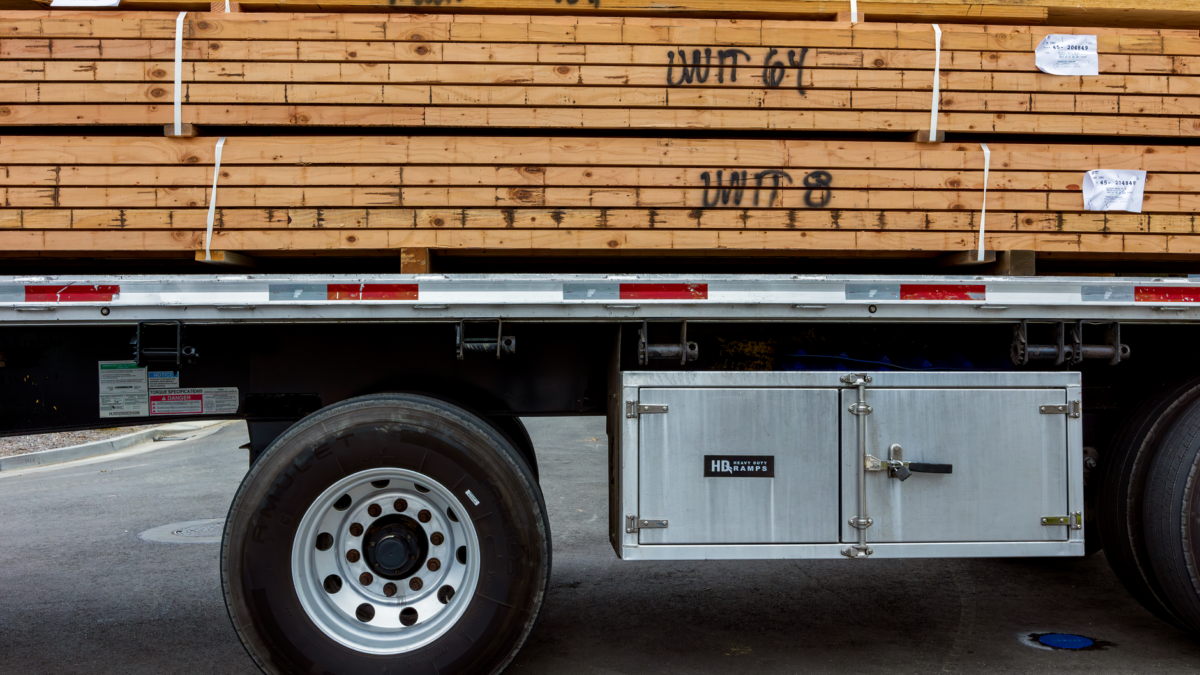
- dressed lumber and building products (393.118);
- metal coils of 5,000 lb or more (393.120), with crossed diagonal tiedowns through the eye on eyes-vertical coils;
- paper rolls of 5,000 lb or more (393.122);
- concrete pipe (393.124);
- intermodal containers (393.126);
- automobiles, light trucks and vans up to 10,000 lb (393.128), with at least 2 tiedowns at front and rear;
- heavy vehicles, equipment and machinery of 10,000 lb or more (393.130), with at least 4 tiedowns and accessories such as buckets lowered and secured;
- flattened or crushed vehicles (393.132), where synthetic webbing may not touch the cars;
- roll-on/roll-off and hook-lift containers (393.134) and large boulders (393.136).
Machinery that needs special fastening because of its size or shape is exempt from the tiedown count in 393.110, but it must still be securely fastened. Very large pieces also raise permit questions covered in our guide to oversize load permits.
When must drivers recheck the load?
Under 49 CFR 392.9, the driver must inspect the cargo and securement devices within the first 50 miles of a trip and adjust or add tiedowns as needed. After that, the driver must recheck whenever the driver changes duty status, or after 3 hours of driving, or after 150 miles, whichever comes first. The rule does not apply to a sealed trailer the driver has been told not to open, or to a load packed so that inspection is impracticable.
Load checks fit naturally into the walkaround described in our guide to the pre-trip inspection and DVIR. At the roadside, inspectors check securement during most DOT inspection levels, and loose or missing tiedowns are a common out-of-service violation.
Bottom line
The two numbers to run before leaving the shipper are the aggregate WLL (half the cargo weight) and the tiedown count by length. A strap rated 5,400 lb counts for only 2,700 lb if it runs from the deck straight to the cargo, so direct tiedowns need twice as many. The full text, including the WLL tables, is in 49 CFR Part 393, Subpart I.
FAQ
Do cargo securement rules apply to dry vans?
Yes. The rules cover all cargo on a commercial motor vehicle, including freight inside a van, which can be secured by the trailer walls, load bars, blocking or dunnage. Bulk liquids, grain, sand and similar loads carried in a tank or hopper are not covered by the general article rules.
What is the WLL of an unmarked 4-inch strap?
The FMCSA table gives 4,000 lb for unmarked 4-inch synthetic webbing. If the strap carries a manufacturer’s WLL tag, the tagged value applies instead.
Can a single tiedown secure a short, light article?
Yes, if the article is 5 feet or shorter and weighs 1,100 lb or less. The aggregate WLL of that one tiedown must still be at least half the article’s weight.
How often must I check my straps on a long trip?
Within the first 50 miles, then at every change of duty status or after 3 hours or 150 miles of driving, whichever comes first.