Truck Classes 1 to 8 and GVWR: Which Weights Trigger Which Rules
Truck classes describe the rating on the door label, and federal rules key off a handful of weight lines. One table maps each line to what it triggers.
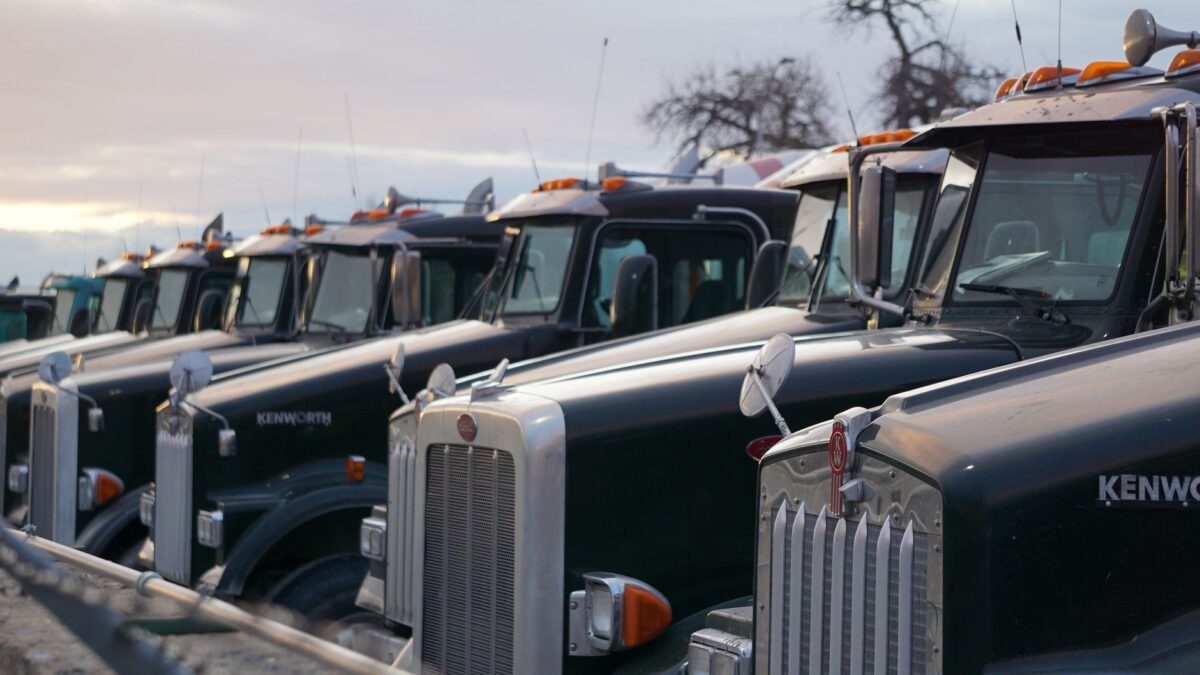
Truck classes 1 to 8 are Federal Highway Administration weight classes based on gross vehicle weight rating (GVWR): Class 8 covers trucks rated over 33,000 lb, which includes nearly every semi tractor. The class itself triggers no rule. Federal requirements start at other lines: 10,001 lb for a USDOT number and medical card, 26,001 lb for a CDL and 55,000 lb for the heavy vehicle use tax.
What is the difference between GVWR, GCWR and GVW?
GVWR is the maximum loaded weight the manufacturer says a single vehicle can carry; GVW is what the vehicle actually weighs at a given moment. The federal definitions in 49 CFR 390.5 read this way:
- Gross vehicle weight rating (GVWR): the value specified by the manufacturer as the maximum loaded weight of a single motor vehicle. It is printed on the certification label, usually on the driver’s door frame.
- Gross combination weight rating (GCWR): the greater of the power unit’s GCWR on its certification label, or the sum of the GVWRs or actual weights of the power unit and everything it tows.
- Gross vehicle weight (GVW) and gross combination weight: the actual weight on the scale, loaded as it is.
The difference matters because most federal thresholds use whichever number is higher: the rating or the actual weight. A pickup rated 9,900 lb that is overloaded to 10,200 lb on the scale has crossed 10,001 lb.
How are truck classes 1 through 8 defined?
The FHWA groups vehicles into eight classes by GVWR, and into light, medium and heavy duty. The U.S. Department of Energy’s Alternative Fuels Data Center publishes the same vehicle weight class table:
| Class | GVWR | Duty category | Typical vehicles |
|---|---|---|---|
| 1 | Under 6,000 lb | Light | Small pickups, SUVs |
| 2 | 6,001 to 10,000 lb | Light | Full-size pickups, cargo vans |
| 3 | 10,001 to 14,000 lb | Medium | Heavy-duty pickups, walk-in vans |
| 4 | 14,001 to 16,000 lb | Medium | Larger walk-in and box trucks |
| 5 | 16,001 to 19,500 lb | Medium | Bucket trucks, large walk-ins |
| 6 | 19,501 to 26,000 lb | Medium | Single-axle box trucks |
| 7 | 26,001 to 33,000 lb | Heavy | Refuse trucks, city tractors |
| 8 | Over 33,000 lb | Heavy | Sleeper and day-cab tractors, dump trucks |
Do not confuse these with the FHWA’s 13-category vehicle classification used for traffic counts, which sorts vehicles by axles and body type rather than weight. Census and EPA groupings also differ.
Which weight thresholds trigger federal trucking rules?
Four weight lines do most of the work for interstate trucks. This table summarizes them as of November 2026:
| Weight line | What it triggers (interstate commerce) | Source |
|---|---|---|
| 10,001 lb GVWR, GCWR or actual weight | Commercial motor vehicle status: USDOT number, DOT medical card, hours of service and ELD rules, roadside inspections, $750,000 minimum liability for general freight carriers | 49 CFR 390.5, Parts 391, 395, 387 |
| 26,001 lb GVWR on a single vehicle | Class B CDL | 49 CFR 383.91 |
| 26,001 lb GCWR with a towed unit over 10,000 lb | Class A CDL | 49 CFR 383.91 |
| Over 26,000 lb, or three or more axles | IFTA fuel tax license and IRP apportioned plates when the vehicle runs in two or more jurisdictions | IFTA and IRP agreements |
| 55,000 lb taxable gross weight | Heavy vehicle use tax on IRS Form 2290 | IRS |
Some rules ignore weight. A vehicle hauling hazmat in an amount that requires placards is a commercial motor vehicle at any weight, and so is one designed or used to carry more than 8 passengers for pay. A small vehicle needs a Class C CDL if it carries 16 or more people including the driver, or placarded hazmat.
When does a pickup and trailer need a CDL?
A pickup and trailer need a Class A CDL when the combination’s GCWR is 26,001 lb or more and the trailer’s GVWR is over 10,000 lb. Both conditions must be met. A 13,000 lb dually pulling a 14,000 lb gooseneck trailer is at 27,000 lb, so the driver needs a Class A. The same truck pulling a trailer rated 10,000 lb stays under the Class A line no matter how heavy the truck is.
The USDOT number line comes much sooner. A pickup rated 9,900 lb pulling a 7,000 lb trailer is a 16,900 lb combination, so it is a commercial motor vehicle in interstate commerce even though the driver needs no CDL. The full set of rigs and requirements is in our guide to hot shot trucking requirements, and the licensing steps are in how to get a CDL.
Why are so many box trucks rated at 26,000 lb?
A box truck rated at 26,000 lb sits one pound under the Class B CDL line, so any driver with a regular license can drive it. That is why rental and lease fleets order Class 6 trucks at that rating. It still needs a USDOT number, a medical card for the driver and logs for interstate work, because it is far over 10,001 lb.
Two-axle trucks rated 26,000 lb or less also stay outside IFTA and IRP. What a non-CDL freight business needs at each weight is covered in box truck business requirements.
Can I lower my truck’s GVWR to avoid a rule?
Only the manufacturer’s rating on the certification label counts. Some owners have a trailer re-rated by its manufacturer, with a new label, to keep a combination under 26,001 lb GCWR. It does not help if the truck is loaded above the rating, because the federal definitions use the higher of the rating and the actual weight. A de-rated truck that runs heavy is both over its rating and inside the rule it was meant to avoid.
Bottom line
A truck’s class tells a buyer roughly what it can carry, but enforcement looks at the specific numbers on the door label and the scale ticket. The heavy vehicle use tax uses its own measure, taxable gross weight: the empty weight of the truck and trailers plus the heaviest load customarily carried. A tractor-trailer that usually grosses 80,000 lb owes $550 a year on Form 2290 even on weeks it runs light.
FAQ
What class is a semi truck?
Nearly all semi tractors are Class 8, rated over 33,000 lb. Some lighter city tractors are Class 7, rated 26,001 to 33,000 lb.
Is a Class 7 truck a CDL vehicle?
Yes. Class 7 starts at 26,001 lb GVWR, which is the Class B CDL line for a single vehicle. Adding a trailer over 10,000 lb makes it a Class A combination.
Does a Class 3 truck need a USDOT number?
For interstate commerce, yes. Class 3 starts at 10,001 lb GVWR, which meets the federal commercial motor vehicle definition. Several states also require a USDOT number for intrastate trucks at that weight.
Where do I find my truck’s GVWR?
On the manufacturer’s certification label, usually on the driver’s door or door frame. Trailers carry their own label, often on the front left side.