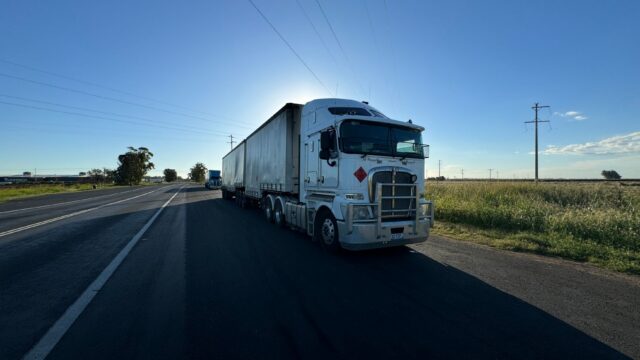
Where Can Truck Drivers Park Overnight? Rules, Options and HOS
A legal spot at the end of the clock is one of the hardest parts of the job. Where trucks can and cannot park overnight, what federal programs exist, and what the hours-of-service rules allow when every lot is full.

Truck drivers can legally park overnight at private truck stops, public rest areas within any posted time limits, shipper or receiver lots with permission, and paid or reserved truck lots. Most cities ban overnight parking of commercial vehicles on residential streets, and shoulders and ramps are generally for emergencies only. Federal hours-of-service rules do not stretch because parking is full.
Where can a truck legally park overnight?
Each option has its own rules. Drivers usually stack several of them on a long run.
| Location | Overnight allowed? | Common limits |
|---|---|---|
| Private truck stops and travel centers | Yes | First come, first served unless reserved; some charge for parking or reserved spots |
| Public rest areas | Depends on the state | Many states post time limits; interstate rest areas cannot host commercial services such as fuel sales under federal law |
| Weigh stations and inspection sites | Sometimes, when closed | Allowed only where the state permits; check posted signs |
| Shipper and receiver lots | Only with permission | Many facilities make trucks leave right after loading or unloading |
| Retail and big-box lots | Only with the owner’s permission | Many stores and local ordinances prohibit it |
| Paid or reserved truck lots | Yes | Paid by the night or by subscription |
| Residential and city streets | Usually no | Local ordinances commonly ban commercial vehicles overnight |
| Highway shoulders and ramps | Emergencies only | Warning devices required within 10 minutes under 49 CFR 392.22 |
Local rules are set by cities and counties and change often. A ticket or tow in a town that bans truck parking can cost more than a night at a paid lot.
What is Jason’s Law?
Jason’s Law is Section 1401 of the 2012 federal highway law known as MAP-21. It made long-term truck parking on the National Highway System a national priority and made truck parking projects eligible for certain federal highway funds. It is named for Jason Rivenburg, a truck driver killed in 2009 while parked at an abandoned gas station because he had nowhere safe to wait for a delivery.
The law also required the US Department of Transportation to survey states on truck parking. FHWA published Jason’s Law survey results in 2015 and an updated 2018 to 2019 survey in December 2020, and says no further survey is expected. In June 2025, FHWA and FMCSA issued a joint memo on which federal highway and safety funds can be used for truck parking, and FHWA’s Truck Parking Development Handbook was updated in 2026. These documents are on the FHWA truck parking page.
How do drivers find open parking?
Drivers find open spaces through a mix of public signs, apps and reservations:
- Truck parking information systems. Several states post the number of open spaces at rest areas and truck stops on roadside signs and in data feeds. Coverage varies by state and corridor.
- Truck stop apps and reservations. Major truck stop chains sell reserved spaces at many locations, usually for a nightly fee, and show availability in their apps.
- Paid secure lots. Private lots near freight hubs rent spaces by the night or month, often with fencing and cameras.
- Shipper arrangements. Some shippers and receivers allow overnight parking for drivers with early appointments; ask when booking, and get it in writing.
Planning the stop before the shift starts matters more than any app. Many drivers set their target parking spot when they check their available hours in the morning, with one or two backups.
What do the hours-of-service rules allow when parking runs out?
The hours-of-service rules have no exception for full parking lots. A driver who reaches the 11-hour driving limit or the end of the 14-hour window must stop driving, even if no legal spot is nearby. Three provisions sometimes help:
- Personal conveyance. FMCSA’s 2018 guidance lets a driver log as off duty the time spent moving the truck, laden or empty, from a shipper or receiver to a nearby, reasonable, safe place to take the required rest. The resting spot must be the first one reasonably available, the move must not advance the load, and it must leave time for the full 10-hour off-duty period before the next driving.
- Adverse driving conditions. Under 49 CFR 395.1(b)(1), a driver may drive up to 2 more hours to finish the run or reach a safe place when unexpected snow, ice, fog or unusual road or traffic conditions arise. The conditions must not have been known before the duty day or dispatch, and the rule’s definition does not include a lack of parking.
- Emergency conditions. A driver may complete a run during an emergency if it could reasonably have been completed without the emergency. This is narrow and fact specific.
Our guide to hours-of-service rules covers the 11-hour, 14-hour and break limits in detail, and ELD rules explained covers how to annotate personal conveyance in the log.
Are any hours-of-service changes coming for parking problems?
FMCSA proposed two pilot programs on September 17, 2025, both limited to about 256 participating drivers. One, the Split Duty Period Pilot Program, would let drivers extend the 14-hour window by pausing it for 30 minutes to 3 hours, taken at a pickup or delivery location. The other would allow more flexible ways to split sleeper berth time. As of October 2026, FMCSA was still seeking federal approval to collect data for the pause pilot, according to a Federal Register notice dated October 6, 2026. Neither pilot changes the rules for drivers outside it.
What if a dispatcher or shipper pushes you to keep driving?
Pressure to drive past your hours because parking is full is a possible violation of the FMCSA coercion rule. A driver who refuses to drive illegally is also protected from retaliation under federal whistleblower law. Deadlines and filing steps are in truck driver coercion and whistleblower rights.
Bottom line
A truck parked at the end of the clock in a spot that is not allowed can get a ticket, but a truck driven past the clock gets an hours-of-service violation that counts against both the driver and the carrier. Shippers that make drivers leave right after unloading are a case FMCSA’s personal conveyance guidance covers, so a log annotation stating that the receiver refused overnight parking is worth adding every time.
FAQ
Can I sleep in my truck at a rest area?
In many states, yes, within posted time limits. Some states have no limit for trucks and others enforce one, so check the signs at each rest area.
Can I park at a big-box store parking lot overnight?
Only with the store’s permission and if local law allows it. Many stores and cities prohibit overnight truck parking, so call ahead or ask the manager.
Is parking on a highway ramp legal?
Generally no, except in an emergency. If you must stop on a shoulder, turn on hazard flashers and place warning devices within 10 minutes under 49 CFR 392.22.
Does personal conveyance let me drive to the next truck stop?
Only to the nearest reasonable safe location, and only if you are not advancing the load. Driving past closer safe spots toward your next stop is counted as driving time.