Hazmat Placard Rules: When a Truck Must Be Placarded and With What
The two placarding tables in 49 CFR 172.504 decide whether a truck shows a placard and which one. A class-by-class table, the exceptions drivers use most, and what has to be in the cab.
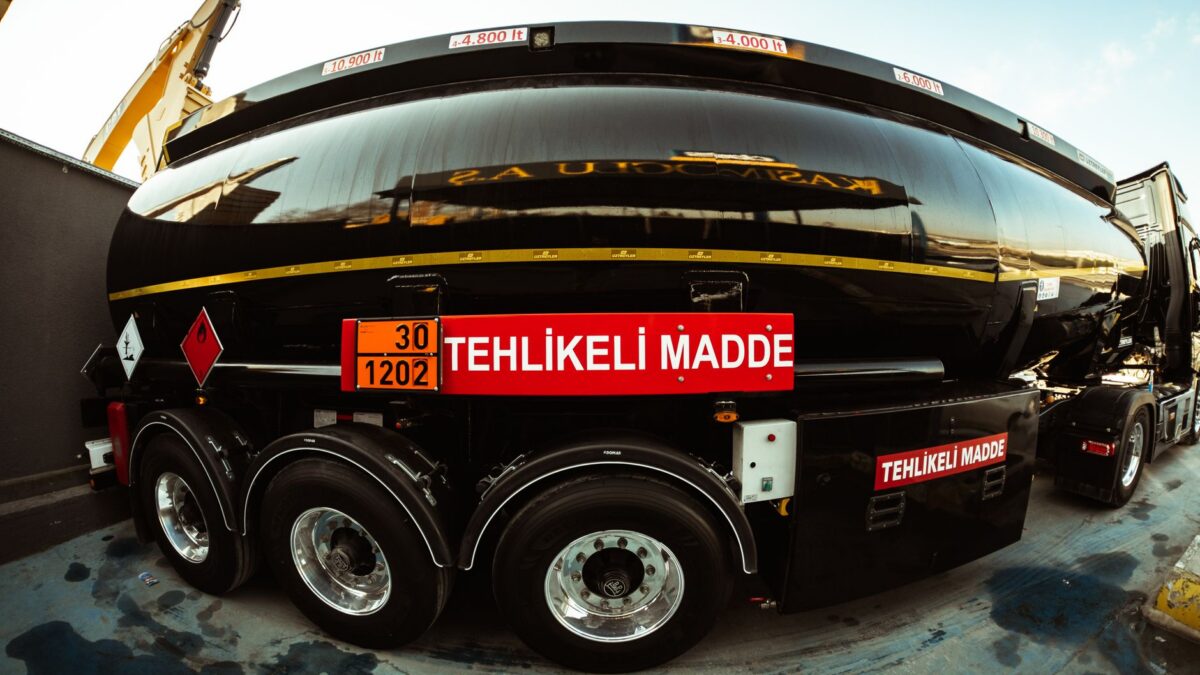
Under 49 CFR 172.504, a truck carrying any amount of a Table 1 hazardous material, such as explosives 1.1 to 1.3 or poison gas, must be placarded. Table 2 materials, which cover most flammable, corrosive and oxidizing loads, need placards only when the vehicle carries 1,001 lb or more aggregate gross weight of them, or when they are in bulk packaging.
When does a truck need hazmat placards?
A truck needs placards on each side and each end when it carries a hazardous material listed in Table 1 in any quantity, or Table 2 materials at 1,001 lb or more aggregate gross weight. The weight counts the material and its packaging for all Table 2 materials on the vehicle together, not each class separately.
The 1,001 lb exception in 172.504(c) does not apply to bulk packagings, such as a cargo tank or a large portable tank. A bulk package of a Table 2 material needs placards whatever the amount. The exception also does not cover materials under 172.505, which adds subsidiary placards for certain poison-by-inhalation and dangerous-when-wet materials.
The full rule is on the eCFR page for 49 CFR 172.504.
Which materials are in Table 1 and Table 2?
Table 1 lists the materials that always need placards. Table 2 lists the rest, subject to the 1,001 lb threshold.
| Hazard class or division | Placard | Table |
|---|---|---|
| 1.1, 1.2, 1.3 Explosives | EXPLOSIVES 1.1 / 1.2 / 1.3 | 1 (any quantity) |
| 2.3 Poison gas | POISON GAS | 1 |
| 4.3 Dangerous when wet | DANGEROUS WHEN WET | 1 |
| 5.2 Organic peroxide, Type B, liquid or solid, temperature controlled | ORGANIC PEROXIDE | 1 |
| 6.1 Poisonous by inhalation | POISON INHALATION HAZARD | 1 |
| 7 Radioactive (Yellow III label) | RADIOACTIVE | 1 |
| 1.4, 1.5, 1.6 Explosives | EXPLOSIVES 1.4 / 1.5 / 1.6 | 2 (1,001 lb or more) |
| 2.1 Flammable gas | FLAMMABLE GAS | 2 |
| 2.2 Non-flammable gas | NON-FLAMMABLE GAS | 2 |
| 3 Flammable liquid | FLAMMABLE | 2 |
| Combustible liquid | COMBUSTIBLE | 2 |
| 4.1 Flammable solid | FLAMMABLE SOLID | 2 |
| 4.2 Spontaneously combustible | SPONTANEOUSLY COMBUSTIBLE | 2 |
| 5.1 Oxidizer | OXIDIZER | 2 |
| 5.2 Organic peroxide (other) | ORGANIC PEROXIDE | 2 |
| 6.1 Poison (other than inhalation hazard) | POISON | 2 |
| 6.2 Infectious substance | None | 2 |
| 8 Corrosive | CORROSIVE | 2 |
| 9 Miscellaneous | CLASS 9 (not required in domestic transport) | 2 |
Class 9 has a special rule. A CLASS 9 placard is not required for domestic transportation, but a bulk package of a Class 9 material must still show its identification number on a placard, an orange panel or a white square-on-point display.
When can you use the DANGEROUS placard?
The DANGEROUS placard may replace separate placards when a vehicle carries non-bulk packages of two or more Table 2 categories that would need different placards. It cannot replace Table 1 placards.
There is a limit. When 2,205 lb (1,000 kg) or more aggregate gross weight of one Table 2 category is loaded at one loading facility, that category’s own placard is required. Example: a trailer with 3,000 lb of Class 8 corrosives and 800 lb of Class 3 flammable liquids, all loaded at one shipper, needs a CORROSIVE placard. The flammable liquids can then be covered by a DANGEROUS placard.
What other placard exceptions do drivers run into?
Section 172.504(f) lists exceptions that remove duplicate placards. The ones seen most on the road:
- With more than one Class 1 division on board, only the placard for the lowest division number is displayed.
- A FLAMMABLE placard may replace COMBUSTIBLE on a cargo tank or portable tank.
- A NON-FLAMMABLE GAS placard is not needed when the vehicle also carries flammable gas or oxygen and shows FLAMMABLE GAS or OXYGEN placards.
- For domestic transport, the OXYGEN placard may replace NON-FLAMMABLE GAS for compressed or refrigerated liquid oxygen.
- For domestic transport, a POISON placard is not needed when the vehicle already shows POISON INHALATION HAZARD or POISON GAS.
Placards may also be displayed when not required, as long as the placard is accurate and not otherwise prohibited.
What papers and emergency information must the driver carry?
Placarded or not, any regulated hazmat shipment needs shipping papers that describe the material: the identification number, proper shipping name, hazard class, packing group, quantity and an emergency response telephone number. The papers must be within the driver’s reach while at the controls, and in a holder on the inside of the driver’s door or on the driver’s seat when the driver is out of the cab, under 49 CFR 177.817(e).
Emergency response information under 49 CFR 172.602 must travel with the shipment. Many carriers meet it with a copy of the Emergency Response Guidebook (ERG) from PHMSA plus the shipper’s information. The ERG gives first responders the initial actions for each identification number. PHMSA publishes it free on its Emergency Response Guidebook page.
Shipping papers for hazmat follow the same basic layout as other freight paperwork; see bill of lading explained for the general fields.
Does the driver need a hazmat endorsement?
A driver needs the H endorsement on a CDL to haul hazardous materials in an amount that requires placarding. A tank vehicle also needs the N endorsement, and the X endorsement combines H and N. Getting an H endorsement means passing a knowledge test and a TSA security threat assessment, which includes fingerprints and a background check. Our guide to CDL endorsements and restrictions explains each code.
Placarded loads also raise insurance minimums for the carrier. Federal minimums for hazmat run from $1 million to $5 million depending on the material, as covered in commercial truck insurance requirements.
Bottom line
The 1,001 lb threshold is the line most general freight carriers live by, and it applies to the total of all Table 2 materials, not each one. A load that crosses it changes three things at once: the placards, the driver’s endorsement requirement and the carrier’s insurance minimum.
FAQ
Do you need placards for under 1,000 lb of hazmat?
Not for Table 2 materials in non-bulk packages under 1,001 lb aggregate gross weight. Table 1 materials, such as Division 1.1 explosives or poison gas, need placards in any amount, and bulk packages always need them.
Does the 1,001 lb include packaging?
Yes. Section 172.504(c) uses aggregate gross weight, which includes the packaging. Add up every Table 2 package on the vehicle.
Can I drive a placarded load without an H endorsement?
No. Hauling hazmat in an amount that requires placards needs a CDL with the hazmat endorsement. Driving without it is a violation for the driver and the carrier.
Are placards needed on an empty tank that hauled hazmat?
Generally yes. A bulk packaging that still holds residue of a hazardous material stays placarded until it is cleaned and purged or refilled with a non-hazardous material. Non-bulk packages with only Table 2 residue do not count toward placarding.